
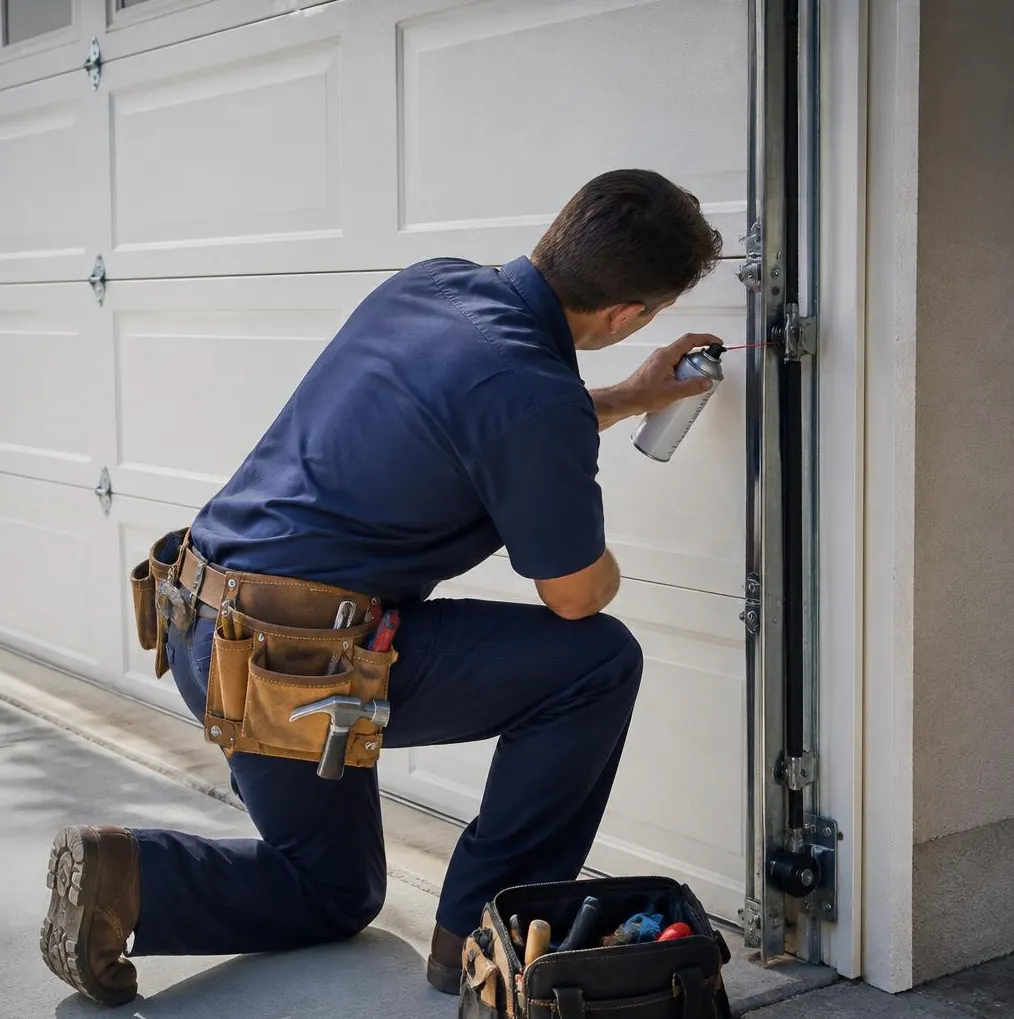
The moment you notice something's wrong
It usually starts with a sound: a loud bang, almost like a gunshot, from inside the garage. Or you hit the opener button and the door barely budges, groaning halfway up before stalling. Maybe you try to lift it manually and it feels like it's bolted to the floor — twice as heavy as it should be. If any of that just happened in your garage, stop. You're almost certainly looking at a broken garage door spring, and what you do in the next five minutes matters more than people realize.
What that spring is actually doing
Most garage doors rely on one or two torsion springs mounted above the door, wound so tightly that they store hundreds of pounds of force. That stored energy is what lifts a door that can weigh well over a hundred pounds. When a spring breaks, all of that tension releases at once — not gently, but violently. A spring under that kind of load doesn't just stop working; it can unwind with enough force to bend the winding bars people use to adjust it, snap cables, or send metal fragments flying across the garage.
How DIY repairs go wrong
Spring replacement looks simple online: unwind the old spring, put in a new one, wind it back up. In practice, it's one of the few home repairs that sends people to the emergency room with real regularity. Here's how it typically happens:
- Wrong winding bars or technique: Without the correct tools and winding sequence, the spring can slip and unwind uncontrolled, striking hands, arms, or faces.
- Wrong spring size: Springs are rated by wire size, length, and winding direction. An improperly matched spring can fail again almost immediately — sometimes while someone is standing underneath the door.
- Cable snapback: Cables under tension can whip violently when a spring lets go, and they're strong enough to cause deep lacerations or crush injuries.
- Door drop: Without the spring's counterbalance, an unsupported door can fall suddenly, which is especially dangerous if hands, feet, or a vehicle are underneath it.
The injuries aren't theoretical — broken fingers, facial trauma, eye injuries, and head injuries from snapped cables or flying hardware are common enough that most professionals treat spring work as a two-person job done with specific torsion tools, never a screwdriver and a ladder.
Why this time of year makes it worse
Heading into winter in Mahoning County, springs and cables take extra abuse. Cold temperatures make metal more brittle and less forgiving, so a spring that was already fatigued from years of cycling is more likely to snap on a cold morning than a mild one. Road salt and ice-melt brine tracked in on tires and boots also accelerates rust on springs, cables, and hardware, weakening them in places you can't easily see from the ground. If your door has felt heavier or noisier over the past few weeks, that's often the first sign of a spring nearing the end of its life — and early fall, before the hard freezes set in, is the right time to deal with it rather than waiting for a snapped spring on a 10-degree morning.
What you can safely do right now
- Look, don't touch: from a few feet away, check for a visible gap in the spring coil above the door — that's the clearest sign it's broken.
- Check cables for fraying or looseness near the bottom brackets, but don't handle them.
- If the door is down, leave it down. Don't force it open manually.
- Disconnect the opener using the manual release cord only if the door is fully closed and resting on the floor, so it can't fall unsupported.
- Keep kids and pets out of the garage until the spring is replaced.
When to call Poland Garage Door
If you've noticed a loud bang, a door that won't move, or a visible gap in the spring, it's time to call. Poland Garage Door handles spring replacement with properly matched, correctly sized torsion springs and the right tools to do it safely — not a trial-and-error approach. While there, they'll also check cables, rollers, and the opener's force settings as part of general garage door maintenance, which matters heading into a Mahoning County winter of ice, salt, and temperature swings.
If your garage door in Poland, OH is making noise, feels heavy, or just went silent and stuck, call Poland Garage Door before you touch that spring. We'll get it fixed right, the first time.